Virtual flooring inspection
Inspections that don't wait for a flight.
Same credentialed inspector network. Same defensible report structure. A live-streamed, structured-protocol inspection that closes the regional roster gap on day-one — not week-three.
The problem
A regional roster gap is not the inspector network failing — it is the inspector network as designed.
Most claims operations rely on a directory of independent inspectors scoped to the metro they live in. When a claim lands two states from the nearest credentialed flooring inspector, the choices are: dispatch a forensic engineer at forensic-engineer rates for a routine flooring inspection, push the claim into a multi-week scheduling cycle, or settle on the contractor-of-record's version. None of these are evidence-grade. All three cost cycle time, money, or defensibility.
Roster gaps on remote claims
A high-value claim in a market with no directory-listed flooring inspector defaults to a generalist or a deferred timeline. Both are losing positions.
Claim-cycle delays
Dispatch lead time on a remote in-person inspection routinely runs 7–14 business days. Virtual closes that gap on the same business day in most markets.
Cost of the wrong inspector tier
A forensic engineer on a routine moisture-mapping job is the wrong tool at the wrong rate. Virtual lets the credentialed flooring inspector do flooring inspector work — without the flight.
How it works
A virtual inspection runs in four steps.
Same protocol as in-person. Same credentialed inspector. The mode of evidence capture changes; the defensibility profile does not.
Schedule the inspection
A claims adjuster files the assignment through the 24/7 platform. Coverage operations confirms the credentialed inspector and a same-day or next-day window — no flight to book, no metro-roster gap to chase.
Connect the field tech
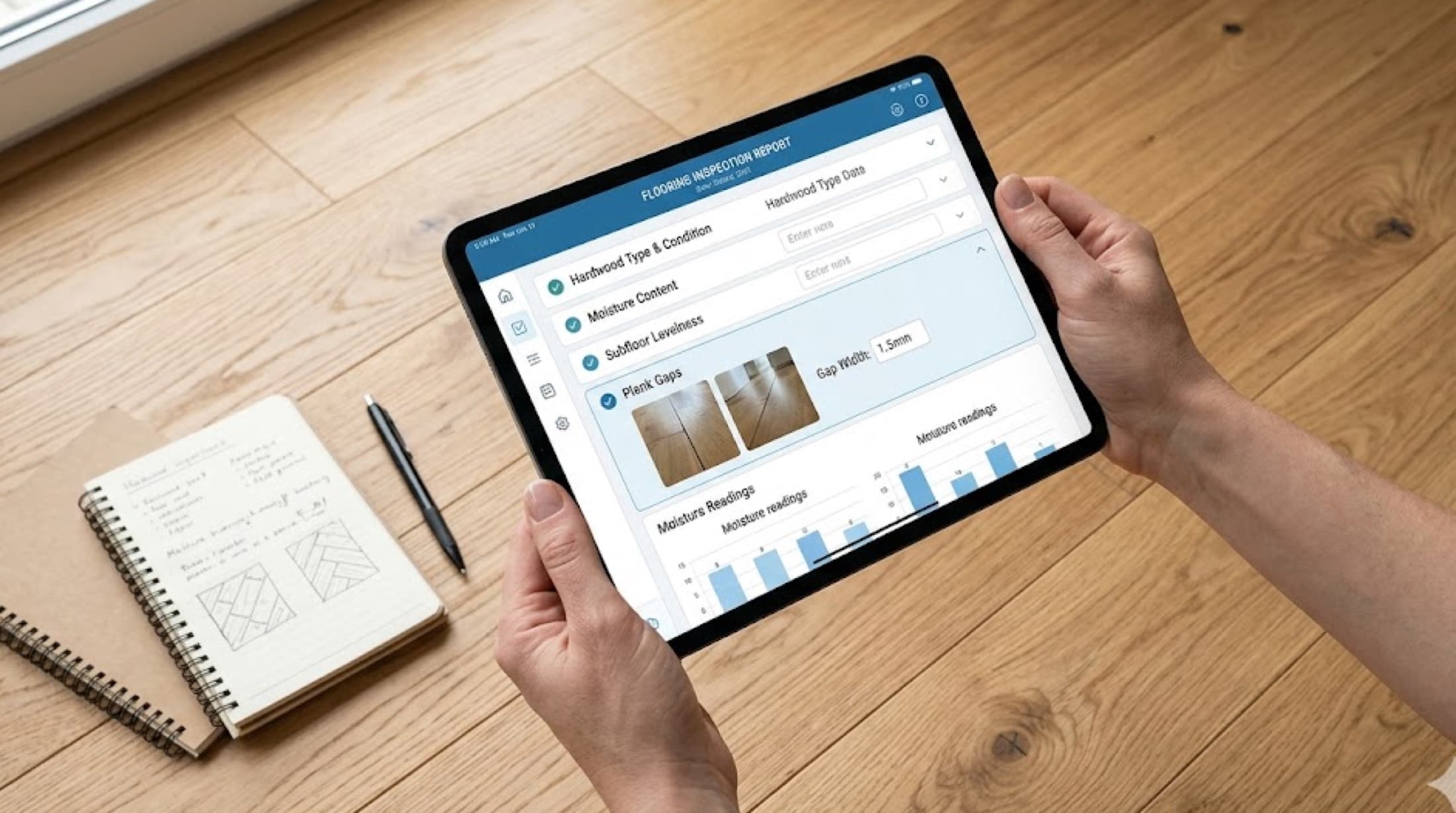
On-site, an authorized party (insured, contractor of record, or a mobilized field tech) joins a live video session from a phone or tablet. The credentialed Inspect Solutions inspector drives the inspection remotely — they are the camera operator by proxy.
Run the structured-protocol checklist
The inspector follows the same published failure-mode taxonomy used in person — moisture mapping, seam analysis, sub-floor probe, photographic captures with chain-of-custody timestamps. Nothing about the protocol is improvised for video.
Receive the cert-backed report
The report is delivered through the 24/7 platform within the same SLA window as an in-person inspection — same anatomy, same expert-qualification footer, same defensibility profile. PDF + structured data, in formats your existing claims ticket already accepts.
What gets inspected
Six concrete assignments where virtual fits.
Each is a routine flooring inspection — not a forensic-engineer scope. The credentialed inspector runs the same protocol they would on-site.
Water-damage assessment
Source identification, affected-area mapping, moisture-meter readings against published thresholds, photographic chain-of-custody.
Installation-defect review
Seam, transition, expansion-gap, and underlayment review against the manufacturer's installation specification and the applicable trade standard (NWFA, NALFA, CFI).
Pet-damage claim documentation
Cause/extent characterization, refinishability assessment, and product-vs-installation isolation — built so the dispute does not hinge on photographs alone.
Manufacturer-defect claim
Independent third-party inspection on warranty-disputed product — failure-mode taxonomy mapped to the cert that governs the claim (NALFA, NWFA, CFI).
Post-mitigation flooring assessment
After-water-mitigation evaluation: what is salvageable, what needs replacement, and which adjacent assemblies require monitoring.
Sub-floor moisture mapping
Pin and pinless meter sweeps, ambient RH/T capture, and a graded moisture map — the evidence panel counsel and product manufacturers ask for first.
The same evidence, evaluated the same way
Virtual is governed by the same inspector network and the same protocol as in-person.
Every Inspect Solutions inspector — virtual or on-site — is NWFA-, IICRC-, CFI-, or NALFA-credentialed and follows the same published failure-mode taxonomy and chain-of-custody protocol. The report deliverable is identical: methodology disclosed, photographic evidence captioned, expert qualifications named. The mode of capture changes; the defensibility profile does not.
Read: virtual vs. in-person inspection| Attribute | Virtual | In-person |
|---|---|---|
| Inspector credential | NWFA / IICRC / CFI / NALFA-credentialed | NWFA / IICRC / CFI / NALFA-credentialed |
| Failure-mode taxonomy | Same published protocol | Same published protocol |
| Chain-of-custody | Timestamped, platform-logged | Timestamped, platform-logged |
| Report deliverable | PDF + structured data, full anatomy | PDF + structured data, full anatomy |
| Typical lead time | Same business day in most markets | 3–14 business days, market-dependent |
Inspector identity, protocol, and chain-of-custody are verifiable today. Lead-time deltas vary by market and are confirmed at assignment acceptance, not advertised as a generic SLA.
Industry credentials
Credentialed by




See the deliverable
See what a virtual inspection report looks like.
Anatomy preview: methodology, photographic captions, chain-of-custody, expert-qualification footer. Email-only download — no procurement gate, no sales call.
Virtual inspection, answered
Five questions buyers ask before the first virtual assignment.
Defensibility, access, connection drop, response time, and the confidentiality question — sourced from carrier-side conversations, not AI-generated filler.
Yes. The report is structurally identical to an in-person Inspect Solutions report — methodology disclosed, chain-of-custody timestamped, photographic evidence captioned against a published failure-mode taxonomy, and signed by a NWFA-, IICRC-, CFI-, or NALFA-credentialed inspector. Every report is built to hold against the insured's contractor, panel-counsel review, and procurement audit. The mode of evidence capture (live video session vs. on-site visit) is disclosed in the methodology section; defensibility is governed by the inspector's credential and the protocol, not by whether the inspector was in the room.
No Inspect Solutions inspector enters the property. An authorized party already on-site — typically the insured, the contractor of record, or a mobilized field technician — joins a live video session from a phone or tablet. The credentialed inspector drives the inspection remotely and operates the camera by proxy. This is a deliberate design choice: it lets us scale the credentialed-inspector network across markets without a physical roster gap, and it removes a category of access-and-scheduling friction that delays remote claims.
The protocol is built around interrupted-connection cases because they are common in remote markets and inside concrete structures. The platform reconnects automatically and the structured-protocol checklist resumes from the last completed step — nothing is re-captured from scratch. If the connection cannot be restored within the inspector's window, the partial capture is logged with a chain-of-custody note and a follow-up session is scheduled, typically same-day. The report discloses any session segmentation in the methodology section.
In most markets, a virtual assignment can be scheduled the same business day it is filed and the report is delivered within the same SLA window as an in-person inspection. The compression vs. in-person comes from removing dispatch and travel time — not from cutting protocol time. SLAs are agreed at the panel level, not advertised here as a generic number; coverage operations confirms a specific window when the assignment is accepted.
Carrier and manufacturer relationships are confidential under NDA. Anonymized stand-ins ("a top-5 US homeowners carrier," "a national LVT manufacturer") are surfaced in the case-study cluster; named references are available on request once mutual NDAs are in place. The procurement dossier is published in advance so vendor diligence can run before a sales call.
Open an assignment
Send the next remote-market claim to a vendor that doesn't wait on a flight.
Open a virtual inspection assignment through the 24/7 platform — same SLA, same credentialed inspector network, same defensible report. Or talk to coverage operations first if your team has not run virtual before.